
D365 License Intelligence Accelerator
Smarter visibility into how Dynamics 365 Finance & Operations is actually used — so license decisions are made with data, not spreadsheets.
Most F&O environments carry more license cost than they need to. The reason is simple — nobody has clean data on who is using which module. This accelerator captures application telemetry directly inside Dynamics 365 Finance & Operations and converts it into practical usage, license, module, and report insights along with recommendations.
Captured application-level, inside F&O
Per user, per module, per object
Usage buckets, aging, top objects
Data-driven, not guesswork
— Why this exists
Why every F&O environment needs this
F&O license spend is often the third or fourth largest line item on a Microsoft renewal. Yet the decision to renew, add, remove, or downgrade licenses is usually made with a Finance-supplied spreadsheet, guesses from module owners, and an internal audit that never quite completes on time.
The gap between what an organisation pays for and what it actually uses in F&O is where the license optimisation opportunity lives — and where the risk of over-buying at the next renewal lives.
This accelerator closes that gap by capturing real user activity inside F&O and turning it into three things administrators and leaders can actually use:
- A per-user view showing usage pattern, current license, activity timeline, and a specific recommendation
- A per-module view showing adoption percentage, aging, top object usage, and whether the module is trending up, flat, or fading
- An object-level view showing which forms, reports, and periodic routines are carrying the workload and which have gone quiet
No consultant interviews. No guesswork. No missed audit deadlines.
— The three screens
What the accelerator shows

User Usage Profile
Provides a consolidated view of each user's usage pattern, license details, activity timeline, and specific recommendation. See at a glance whether a user is genuinely active, occasional, or effectively dormant — and whether their current license level fits their actual usage.
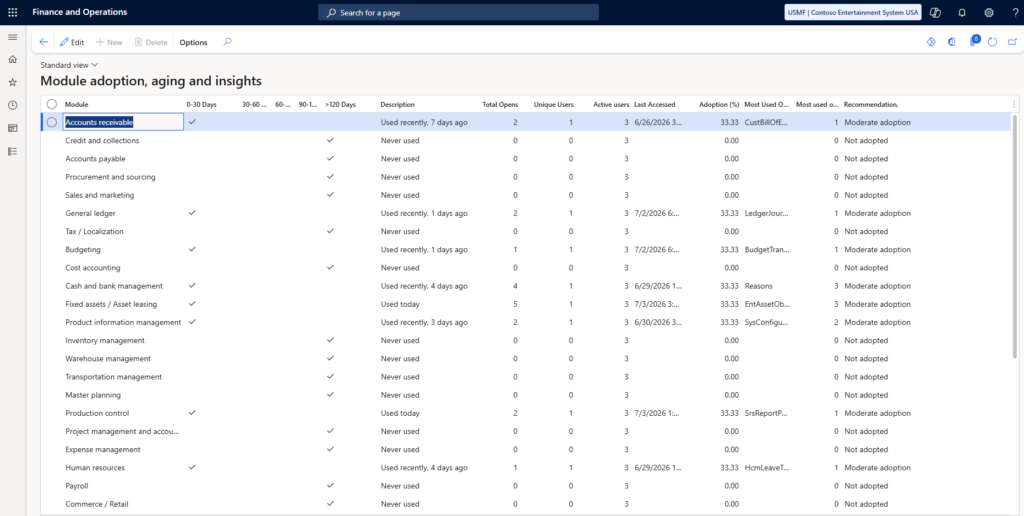
Module Adoption, Aging and Insights
Combines module usage, aging buckets, last-accessed information, adoption percentage, top object usage, and adoption recommendation. Answers the question every leadership team asks and no one has clean data for: which modules are we actually using?
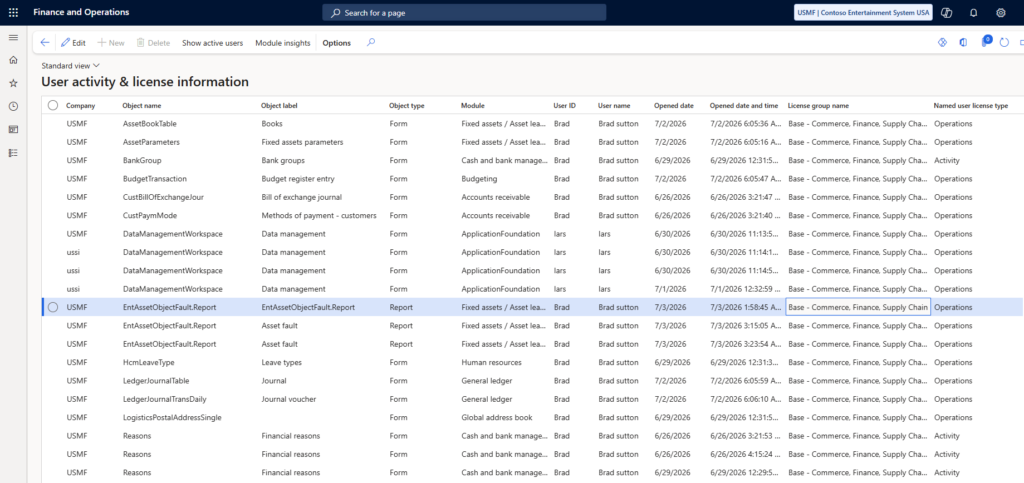
User Activity & License Information
Drill-down telemetry showing object-level activity with module and license context for forms, reports, and periodic routines. When the higher-level views raise a question, this is where the answer lives.
— What organisations do with it
Practical use cases
- Prepare for Microsoft renewal — go into the renewal conversation with real usage data, not vendor-supplied entitlement numbers
- Consolidate licenses — identify users on a higher license tier than their actual usage justifies
- Support module retirement decisions — surface modules that are effectively unused so retirement can be scoped
- Identify low-adoption modules for retraining — modules that are licensed and installed but never used
- Back a license audit — deliver evidence-based conclusions rather than sample-based estimates
- Support M&A due diligence — quickly build a picture of F&O usage in an acquired entity
— How it works
How the accelerator works
Deploy inside F&O
Deployed as an extension inside the client's Dynamics 365 F&O environment. No external data pipeline, no exports to third-party analytics tools, no data leaving the tenant.
Capture telemetry
Application-level telemetry captures user activity against forms, reports, and periodic routines. Data stays inside the F&O environment and its associated storage.
Report and recommend
The three screens surface the analysis. Recommendations are generated from the underlying telemetry patterns — usage frequency, last-accessed dates, license level relative to activity — and are supported by the raw data underneath.
— Who this is for
- F&O administrators who own the license utilisation conversation with Finance
- IT leaders preparing for the next Microsoft renewal
- Finance leaders who want data-backed license decisions, not vendor-driven ones
- Microsoft partners managing F&O environments on behalf of end-user clients
- M&A integration teams needing rapid F&O adoption baselines across acquired entities
— FAQ
Frequently Asked Questions
Is data ever exported outside our F&O environment?
No. The accelerator runs inside your Dynamics 365 Finance & Operations environment. Telemetry stays inside the tenant.
Do we need Power BI to see the reports?
The accelerator’s three primary screens are built inside the F&O interface itself. Where organisations want to combine the telemetry with other data sources, Power BI integration is straightforward but optional.
How long does deployment take?
For a standard F&O environment, deployment is a matter of days rather than weeks. Custom environments with heavy ISV extension footprints may need additional testing.
Does the telemetry capture affect F&O performance?
The accelerator is designed to run without noticeable performance impact on the F&O environment. Load testing is part of every deployment.
Can this be white-labelled for Microsoft partners to deploy for their clients?
Yes. MTC delivers this on a white-label basis for Microsoft partners as well as directly for end-user organisations.