
Microsoft Dynamics 365 Portal Development - Power Pages, Custom Portals & AP Automation
MTC builds customer self-service portals, partner collaboration hubs, employee portals, and AP automation portals - on Microsoft Power Pages or with custom React/.NET frameworks. Deep integration with Dynamics 365, Dataverse, Business Central, Field Service, and Customer Service. Built secure-by-default with Azure AD, API Management, and Azure Sentinel monitoring.
Nine portal solutions covering every business need - from customer self-service to AP automation. All built on Microsoft technology, deeply integrated with your Dynamics 365 backend, and customized for your industry and workflows.
Customer Portals
Empower your clients with 24/7 self-service for case management, knowledge base access, billing inquiries and appointment scheduling, reducing support load and boosting satisfaction.
Partner & Vendor Portals
Streamline onboarding, contract approvals and order processing with secure, role-based hubs that foster collaboration and visibility across your supply chain.
Employee & HR Portals
Optimize workforce productivity with intuitive leave requests, training modules, HR document libraries and automated approval workflows.
Field Service Portals
Accelerate service delivery with real-time job updates, mobile inspections, timesheet capture and feedback tools—so technicians stay informed and customers stay happy.
QA & Survey Portals
Deliver role-based case management alongside fully brandable survey experiences to collect actionable feedback and close the loop faster.
Tenant & Building Portals
Give property managers, tenants and service teams a unified, mobile-first interface for maintenance requests, lease documents and onsite communications.
Custom Web Portals
Build tailor-made experiences using Microsoft Power Pages or React/.NET frameworks, with pro-code extensibility and seamless Dataverse integration.
Portal + CRM Integration
Achieve end-to-end automation by embedding portal data directly into Dynamics 365 and Dataverse, driving unified workflows and real-time reporting.
AP Automation Portals
Leverage Azure AI to automatically ingest PDF invoices, extract vendor and line-item data, and generate vouchers in Dynamics 365 Business Central—cutting manual entry, slashing errors and speeding up your payables cycle.
Enterprise-Grade Security
Protect every transaction, user and data store with
- Azure AD & RBAC: Fine-grained permissions and conditional-access policies.
- API Management & CORS: All APIs fronted by Azure API Management, enforcing CORS, JWT validation, rate-limits and AAD/B2C/SSO authentication.
- Compliance-Ready: End-to-end encryption, audit trails via Azure Monitor, and SIEM integration with Azure Sentinel.
Intelligent Automation & AI
Turn data into action with built-in cognitive services
- PDF & Invoice Processing: Form Recognizer and Cognitive Search auto-ingest invoices, extract line-item data and generate vouchers in Business Central
- Predictive Insights: Embedded Azure ML models and Power BI dashboards forecast SLAs, maintenance needs and customer trends
- Conversational Bots: LUIS-powered chatbots handle FAQs, submit support cases or trigger workflows—24/7, zero-touch
Seamless Integration & APIs
Unify your systems into one cohesive workflow
- Dynamics 365 & Dataverse Connectors: Real-time sync with Customer Engagement, Business Central, Field Service and custom entities
- EDI & B2B Gateways: Azure Logic Apps transform X12/EANCOM messages, exposed securely through APIM for trading-partner exchanges.
- Event-Driven Architecture: Azure Event Grid and Functions deliver instant notifications and bidirectional data updates.
Modern UX & Global Scale
Deliver beautiful, responsive portals—anywhere, on any device
- Power Pages & Custom Frameworks: Choose low-code or pro-code (React/.NET) for pixel-perfect UI and offline-ready PWAs
- Multi-Tenant, Multi-Lingual: Geo-distributed with Azure Traffic Manager & CDN, serving localized content to global audiences
- Embedded Analytics & Dynamic Forms: In-page Power BI visuals and Dataverse forms keep users in context—no app-switching.
Real-World Industry Use Cases Driving Digital Transformation
Finance & Accounting
AP Automation portal leveraging Azure AI for PDF invoice ingestion, data extraction and voucher generation in Business Central.
Cleaning & Facilities Management
Franchisee portal for training, scheduling, supply ordering and performance tracking across multi-location networks.
Distribution & Logistics
Vendor portal for onboarding, contract management, order processing and shipment visibility in real time.
Real Estate & Property Management
Tenant portal for lease management, maintenance requests, community updates and mobile support.
Healthcare & Wellness
Patient portal with appointment booking, billing inquiry, medical record access and knowledge-base integration.
Nonprofit & Social Services
Volunteer coordination portal (e.g. dog-helper matching), service request management and impact reporting.
Integrated tools and scalable platforms to optimize CRM workflows and enhance productivity.
Power Platform

Power Pages (Power Apps Portals), Power Automate, Power BI Embedded
Dynamics & Data
Dynamics 365, Dataverse, Azure SQL, Cosmos DB
Azure Services
App Service, Functions, Logic Apps, API Management, AD B2C/OAuth
Custom Frameworks
React, Next.js, .NET, Tailwind CSS
Integration & Security
Azure Service Bus, Event Grid, EDI/X12 via APIM, Azure Key Vault
Collaboration
SharePoint, Teams integration
Microsoft-Certified Experts
Our team holds Gold and Silver competencies in Dynamics 365, Power Platform and Azure—so you get best-practice solutions and ongoing support.
Enterprise-Grade Security
We design every portal with Azure AD, API Management, CORS and Sentinel monitoring baked in—so your data and users stay protected.
End-to-End Portal Services
From low-code Power Pages to custom React/.NET builds, plus seamless CRM/ERP integration and Azure AI automation, we cover the full lifecycle.
Tailored for Your Industry
Whether it’s AP-automation in finance, tenant portals in real estate or volunteer platforms for nonprofits, we bring deep vertical knowledge.
Our Process
6 SIMPLE STEPS
Discovery & Prototype
Stakeholder workshops and clickable mock-ups to lock down requirements.
Design & Architecture
Finalize wireframes, UI specs, data model and information architecture.
Development & CI/CD
Iterative sprints (Power Pages or custom React/.NET) with automated builds and deployments.
Integration & Testing
Connect to Dynamics 365, Dataverse and external APIs. Run UAT and performance checks.
Security & Deployment
Configure Azure AD roles and API Management/CORS. Roll out with training and cutover support.
Ongoing Support
SLA-backed helpdesk, regular health reviews and continuous enhancements.
Trusted By

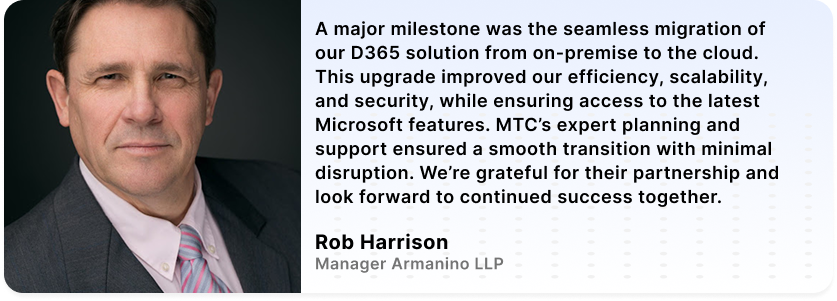
Five core principles that guide every portal we build. They shape how we design, how we secure, and how we support - from the first stakeholder workshop through years of partnership.
User-Focused
We design portals around real-world usage
Secure by Default
Privacy, compliance, and role protection are non-negotiable
Performance-Driven
Fast load times and scalable architecture
Connected
Every portal is designed to work with your ecosystem
Continuous Innovation
We keep your portals future-ready
Explore the right solution to match your business vision
Receive customized pricing that fits your needs
Uncover smarter ways to align and streamline team workflows
- Automate complex workflows.
- Improve customer engagement.
- Enable real-time visibility.
- Support modern service delivery models
Contact our sales team
Frequently Asked Questions
Power Pages vs custom React/.NET portal - which should I choose?
Power Pages is faster to build and integrates natively with Dataverse – ideal for standard customer/partner/employee scenarios. Custom React/.NET portals are needed when you require pixel-perfect custom UX, complex workflows beyond Power Pages limits, or offline-ready PWAs. MTC builds both – see our Microsoft Power Pages services for portal-led engagements, or contact us for custom React/.NET builds.
How long does a typical portal project take?
Power Pages standard portals: 4-8 weeks. Custom React/.NET portals: 8-16 weeks. Enterprise portals with complex integrations: 4-6 months. AP Automation portals with Azure AI: 6-10 weeks. Timelines reduced 30-40 percent vs traditional shops due to AI-accelerated development.
What's included in your AP Automation Portal solution?
Azure AI Form Recognizer for PDF invoice ingestion, automatic vendor and line-item extraction, voucher generation in Dynamics 365 Business Central, approval workflows, vendor onboarding, audit trails, and Power BI dashboards for AP visibility.
Can my portal work with my existing Dynamics 365 customizations?
Yes. MTC builds portals that respect your existing Dynamics 365 customizations – custom entities, business rules, plugins, and security models. The portal becomes an extension of CRM, not a separate system.
How do you handle portal security?
Azure AD with conditional access, API Management with JWT validation and rate limiting, Azure AD B2C for external users, CORS policy enforcement, Azure Key Vault for secrets, Azure Sentinel for SIEM monitoring, and full audit trails via Azure Monitor.
Do you offer ongoing portal support after launch?
Yes. SLA-backed helpdesk, regular health reviews, continuous enhancements. Available through MTC’s Managed Services tiers – including 24/5 AI-powered managed services with Claude AI first-level issue analysis from $1,500/month.
What industries do you build portals for?
Finance & accounting (AP automation), cleaning & facilities (franchise portals), distribution & logistics (vendor portals), real estate (tenant portals), healthcare (patient portals), nonprofit (volunteer portals), and many more. Custom-fit to your specific vertical needs.
How does AI integration work in your portals?
Azure OpenAI for intelligent document processing, Cognitive Services for entity extraction, AI Search for portal search, Copilot Studio for conversational bots, and Power Automate AI Builder for workflow intelligence. Real-world example: AP Automation portal where AI extracts invoice data in seconds instead of minutes of manual entry.